Can Chiropractic Care Help IT Band Syndrome?
If a sharp, burning pain on the outside of your knee shows up a mile or two into your run, forces you to stop, and then mysteriously fades once you do, you're describing the classic pattern of IT band syndrome. It's the most common cause of outer knee pain in runners and one of the most frequent overuse injuries in cyclists as well, which is why so many people spend months foam rolling their outer thigh with little to show for it.
In this article, we'll explain what the IT band actually is, what's really happening at the knee, why the usual self-treatment often fails, and how chiropractic care at Modern Care Chiropractic addresses the true causes.
What Is the IT Band?
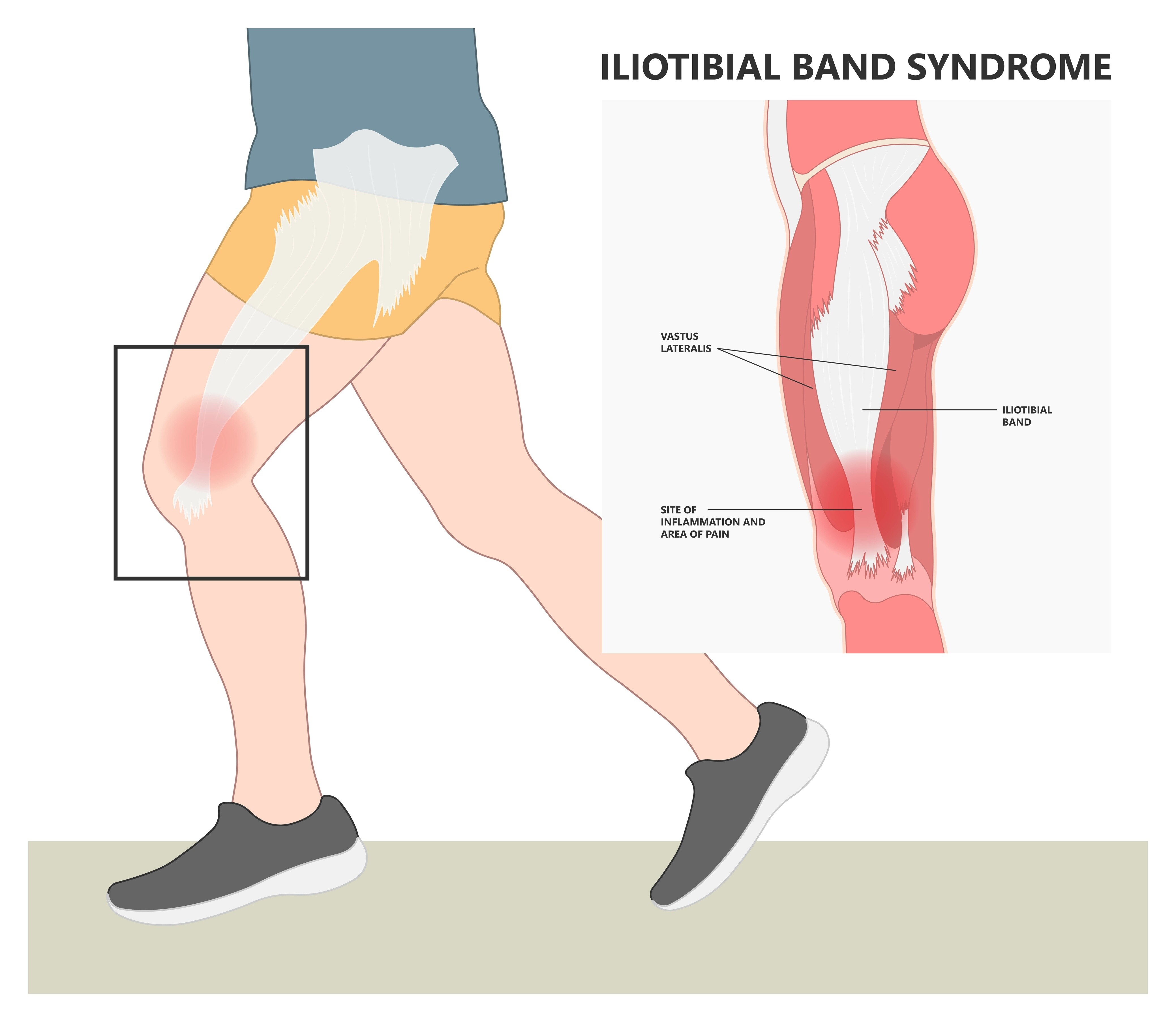
The iliotibial band is a thick, fibrous band of connective tissue that runs down the outside of the thigh, from the rim of the pelvis to a bony bump on the outer shin just below the knee called Gerdy's tubercle. It isn't a muscle itself. Instead, it serves as a long tendon-like extension for two muscles that attach into its upper end: the tensor fasciae latae at the front of the hip and portions of the gluteus maximus at the back.
Functionally, the IT band helps stabilize the outside of the hip and knee during single-leg activities like running, where your entire body weight lands on one leg. When it's working well, you never notice it, but when it weakens or becomes irritated, the lower end of the band, where it crosses the outer knee, becomes the site of trouble.
What Actually Happens in IT Band Syndrome?
For years, IT band syndrome was described as a friction problem, with the band supposedly snapping back and forth across the bony prominence on the outer knee (the lateral femoral epicondyle) with each stride. More recent anatomical research paints a different picture. The IT band is firmly anchored to the femur and doesn't truly slide forward and back. Instead, the problem appears to be compression: as the knee repeatedly bends and straightens through roughly 20 to 30 degrees, the band compresses a sensitive layer of fat and connective tissue rich in nerve endings between itself and the bone. Repeat that compression thousands of times, and the tissue becomes inflamed and painful.
The IT band itself is enormously strong, with tensile strength comparable to steel, and it cannot be meaningfully lengthened or "released" by foam rolling. The band isn't too tight so much as it's being overloaded, usually because the muscles that should be controlling hip and leg alignment aren't doing their job.
What Causes IT Band Syndrome?
IT band syndrome is a load and control problem. The most common contributors include:
- Weak hip abductors, particularly the gluteus medius, which allow the hip to drop and the knee to drift inward with each stride
- Sudden increases in running mileage or intensity
- Downhill running, which increases the time the knee spends in the painful compression zone
- Cycling with a saddle set too high or cleats poorly positioned
- Running on cambered road surfaces, which tilts the pelvis and unevenly loads one leg
- Leg length differences and foot mechanics that alter alignment up the chain
The hip weakness piece is the most consistent finding in the research. When the gluteus medius can't hold the pelvis level during single-leg stance, the thigh angles inward, tension through the IT band rises, and compression at the outer knee increases with every step. This is why lasting treatment focuses heavily on the hip, not just the spot that hurts.
Common Symptoms of IT Band Syndrome
The hallmark is sharp, burning, or aching pain localized to the outside of the knee, typically about two centimeters above the outer joint line. The pain follows a predictable pattern: it often starts at a consistent distance or time into a run, worsens until running becomes difficult, and eases quickly with rest, only to return at the same point next time. Pain is usually worst with downhill running and descending stairs, since these load the knee in the sensitive range of bend. The outer knee may be tender to press on, and some people notice a sensation of snapping or tightness along the outer thigh. Unlike injuries inside the knee joint, IT band syndrome doesn't typically cause swelling within the knee, locking, or instability.
How Does a Chiropractor Treat IT Band Syndrome?
Because IT band syndrome is driven by mechanics along the whole lower body, chiropractic care is well suited to addressing the actual causes. At Modern Care Chiropractic, treatment typically includes several components.
A full kinetic chain assessment. Including hip strength and control, pelvic alignment, foot and ankle mechanics, leg length, and your gait or running pattern. Tests like the single-leg squat often reveal the hip drop and inward knee drift that load the IT band, and identifying your specific pattern shapes the treatment plan.
Joint adjustments and mobilization. Restrictions in the pelvis, hip, knee, foot, or lumbar spine change how load travels through the leg. Targeted adjustments restore normal joint motion so the limb can align properly during activity, reducing the strain funneled into the outer knee.
Soft tissue therapy. Rather than attacking the band itself, effective soft tissue work targets the muscles that attach into it and control its tension, especially the tensor fasciae latae, gluteal muscles, and outer quadriceps. Myofascial release and trigger point therapy reduce the muscular tension feeding the problem, and instrument-assisted work can address irritated tissue near the knee.
Class IV therapeutic laser therapy. Laser therapy helps calm inflammation in the compressed, irritated tissue at the outer knee and supports healing alongside manual treatment.
Corrective exercise. This is the cornerstone of lasting recovery. We prescribe progressive strengthening for the gluteus medius and hip stabilizers, along with single-leg control work that retrains proper alignment under load. Strengthening the hip is what actually reduces the compressive overload at the knee.
Most patients improve significantly within four to six weeks of consistent care, with a full return to training over six to eight weeks depending on how long the problem existed before treatment.
What Can You Do at Home?
Reduce, rather than eliminate, the activities that provoke pain, and temporarily avoid downhill running and long descents on stairs when symptoms are flared. Ice the outer knee for 10 to 15 minutes after activity to calm irritation. Strengthening work is where home effort pays off most: exercises like side-lying leg raises, clamshells, single-leg bridges, and lateral band walks build the hip control that protects the knee. Foam rolling the outer quadriceps and gluteal muscles can ease muscular tension, but rolling directly on the IT band itself, especially near the painful outer knee, tends to aggravate the compressed tissue without changing the band.
What you should avoid is the cycle of resting until pain fades, then returning to full training with the same weak hips and same mechanics. That's the recipe for the recurrence this injury is famous for.
When Should You See a Professional?
If outer knee pain has persisted more than two weeks despite cutting back activity, keeps ending your runs at a predictable point, or is starting to bother you on stairs and daily walking, it's time for an evaluation. You should also seek assessment if your knee is swelling, locking, giving way, or if the pain is inside the joint rather than on the outer edge, since those signs point toward other knee conditions that need a different approach.
Frequently Asked Questions About IT Band Syndrome
Can a chiropractor really help with IT band syndrome?
Yes. IT band syndrome is a mechanical overload problem involving the hip, pelvis, knee, and foot, which makes it well suited to chiropractic care. Treatment combines joint adjustments, soft tissue therapy for the muscles controlling the band, and progressive hip strengthening, addressing the causes rather than just the painful spot.
Why does my knee only hurt when I run, not when I walk?
The painful compression occurs when the knee bends through roughly 20 to 30 degrees under load, a zone your knee passes through repeatedly while running, especially downhill. Ordinary walking keeps the knee outside that range for the most part, which is why many people with IT band syndrome walk comfortably but can't run more than a couple of miles.
Does foam rolling the IT band work?
Not the way most people hope. The IT band is extremely strong connective tissue that cannot be lengthened or released by rolling. Foam rolling the muscles around it, like the outer quadriceps and glutes, can ease tension and feel helpful, but rolling directly on the band, particularly near the painful knee, often irritates the already-compressed tissue. Lasting improvement comes from strengthening the hips and correcting mechanics.
How long does IT band syndrome take to heal?
With appropriate treatment and training modification, most cases improve substantially within four to six weeks, with a full return to running over six to eight weeks. Long-standing cases that have been repeatedly pushed through can take longer, which is another reason early treatment pays off.
Why does IT band syndrome keep coming back?
Because rest alone treats the symptom, not the cause. If hip weakness, poor single-leg control, training errors, or bike fit problems remain unaddressed, the same overload returns as soon as full activity resumes. Completing a hip strengthening program and correcting the contributing mechanics is what breaks the cycle.
Is IT band syndrome the same as runner's knee?
No. Runner's knee, or patellofemoral pain syndrome, causes pain around or behind the kneecap at the front of the knee. IT band syndrome causes pain specifically on the outer side of the knee. The two share some contributing factors, like hip weakness, but they're distinct conditions with different pain locations and somewhat different management.
Get Relief from IT Band Syndrome at Modern Care Chiropractic
You don't have to keep cutting runs short at the same painful mile marker. At Modern Care Chiropractic, we identify the mechanics overloading your IT band, treat the irritated tissue, and build the hip strength that keeps the problem from coming back.
Ready to get started? Give us a call at 702-900-2709 or use our online booking site to schedule your evaluation today.
This article is for informational purposes only and is not a substitute for professional medical advice, diagnosis, or treatment. Always consult a qualified healthcare provider about your specific condition.