Understanding Rotator Cuff Injuries and Your Treatment Options
If reaching overhead, lifting a grocery bag, or rolling onto your side at night sends a sharp ache through your shoulder, there's a good chance your rotator cuff is involved. Rotator cuff problems are among the most common causes of shoulder pain in adults, and they range from mild irritation to full tendon tears. The encouraging news is that many rotator cuff injuries improve with conservative, non-surgical care, especially when treatment starts early.
In this article, we'll explain what the rotator cuff is, how injuries happen, what symptoms to watch for, and how chiropractic care at Modern Care Chiropractic can help you regain a strong, pain-free shoulder.
What Is the Rotator Cuff?
The rotator cuff is a group of four muscles and their tendons that surround the shoulder joint, connecting your shoulder blade (scapula) to the upper arm bone (humerus). Together, these muscles hold the ball of the shoulder joint centered in its shallow socket and allow you to lift and rotate your arm. Each of the four plays a distinct role:
- Supraspinatus runs along the top of the shoulder blade and initiates lifting the arm out to the side. It is the most frequently injured of the four, largely because its tendon passes through a narrow bony tunnel called the subacromial space, where it is vulnerable to compression and wear.
- Infraspinatus sits on the back of the shoulder blade and is the primary external rotator of the arm, the motion you use when reaching back to throw or grabbing a seatbelt. It is the second most commonly injured rotator cuff muscle.
- Teres minor is a smaller muscle just below the infraspinatus that assists with external rotation and helps stabilize the joint during overhead movement.
- Subscapularis covers the front surface of the shoulder blade and powers internal rotation, such as reaching behind your back or tucking in a shirt. It is the largest and strongest of the four.
Because the shoulder is the most mobile joint in the body, its socket is shallow by design, sometimes compared to a golf ball sitting on a tee. That mobility comes at the cost of built-in bony stability, so the joint relies heavily on the rotator cuff to keep the humeral head centered during every arm movement. This constant stabilizing demand is exactly what makes these tendons vulnerable to strain and overuse injury.
Rotator cuff problems exist on a spectrum. They include tendinopathy, where the tendon becomes irritated or degenerated from repetitive load exceeding its capacity to repair; partial-thickness tears, where some tendon fibers are damaged but the tendon remains attached; and full-thickness tears, where the tendon pulls completely away from its attachment on the humerus. Subacromial impingement, where the supraspinatus tendon and the fluid-filled bursa above it get compressed between the humeral head and the bony arch of the shoulder (the acromion), often accompanies or precedes these issues. Many people also have some combination, such as impingement irritating an already-degenerated tendon, which is why an accurate assessment matters before treatment begins.
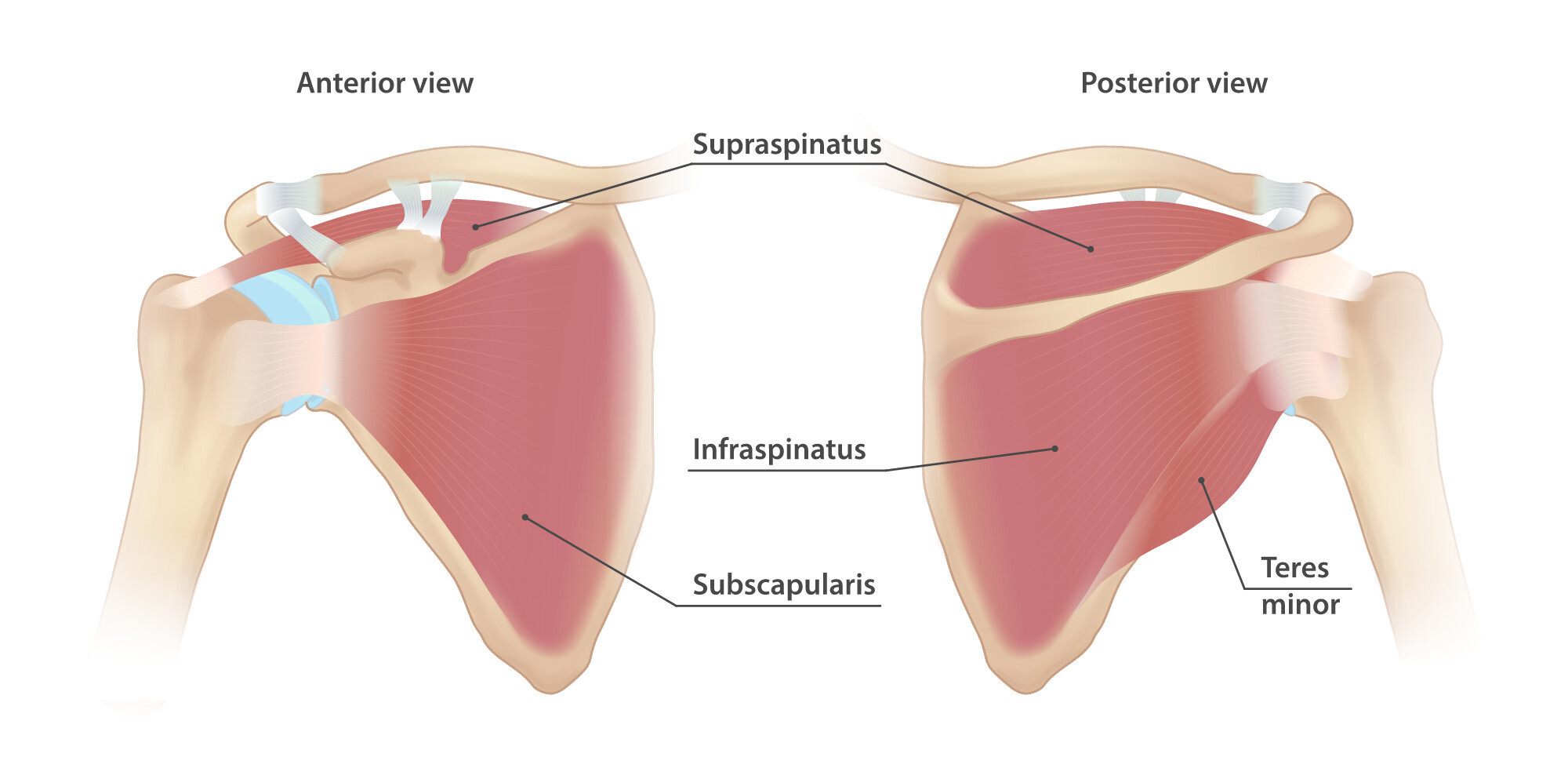
Image Source: www.Injurymap.com
What Causes Rotator Cuff Injuries?
Rotator cuff injuries develop in two main ways: gradually through repetitive strain, or suddenly through acute trauma. Common contributing factors include:
- Repetitive overhead motion from sports like swimming, baseball, tennis, and weightlifting
- Occupations involving overhead work, such as painting, construction, or stocking shelves
- Age-related tendon degeneration, which becomes increasingly common after 40
- Falls onto an outstretched arm or the shoulder itself
- Lifting something too heavy or with poor mechanics
- Poor posture and shoulder blade mechanics that narrow the space where the tendons glide
That last factor is often overlooked. Normally, the shoulder blade and upper arm move together in a coordinated pattern called scapulohumeral rhythm: for every degree the shoulder blade rotates upward, the arm moves roughly two degrees. Rounded shoulders, a forward head posture, or weakness in the muscles that control the shoulder blade, particularly the serratus anterior and lower trapezius, disrupt this rhythm. When the shoulder blade fails to rotate and tilt properly during arm elevation, the subacromial space narrows and the rotator cuff tendons get compressed with every overhead movement. This is one reason treating only the painful spot, without addressing posture and shoulder blade mechanics, often leads to recurring problems.
It's also worth understanding why these tendons struggle to heal on their own. The supraspinatus tendon in particular has a zone of relatively poor blood supply near its attachment point, which limits its capacity to repair microdamage. When repetitive strain outpaces this slow repair process, the tendon gradually degenerates, a condition sometimes called tendinosis, even without a single identifiable injury.
Common Symptoms of a Rotator Cuff Injury
The classic symptom is a dull, aching pain deep in the shoulder or along the outside of the upper arm that worsens with overhead activity or reaching behind your back. Many people also experience pain that disrupts sleep, especially when lying on the affected side, along with weakness when lifting or rotating the arm. Some notice a clicking or catching sensation with certain movements, and a painful arc is common, where the shoulder hurts most between roughly 60 and 120 degrees of arm elevation but eases above and below that range. With larger tears, weakness can be pronounced enough that raising the arm becomes difficult.
The location of your weakness can also hint at which muscle is involved. Difficulty initiating a sideways arm raise suggests the supraspinatus, weakness rotating the arm outward points to the infraspinatus or teres minor, and trouble reaching behind your back or pressing the hand into the belly implicates the subscapularis. During your exam, specific orthopedic tests for each muscle help narrow down the source.
Symptoms that come on gradually and worsen over months typically point to overuse-related tendinopathy, while sudden pain and weakness after a fall or forceful lift may indicate an acute tear that deserves prompt evaluation.
How Does a Chiropractor Treat Rotator Cuff Injuries?
Chiropractic care offers a conservative, non-surgical approach that addresses both the injured tissue and the mechanical problems that contributed to it. At Modern Care Chiropractic, treatment typically includes several components.
A comprehensive shoulder and postural assessment. We evaluate not just the shoulder itself, but the shoulder blade mechanics, mid-back mobility, neck, and posture. Restrictions anywhere in this chain can overload the rotator cuff, so identifying the full pattern is essential for lasting results.
Joint adjustments and mobilization. Gentle, targeted mobilization of the shoulder, shoulder blade, and mid-back helps restore normal joint motion and reduce the mechanical pinching that irritates the rotator cuff tendons. If restrictions in the neck or upper back are altering shoulder mechanics, those areas are addressed as well.
Soft tissue therapy. Techniques such as myofascial release, instrument-assisted soft tissue mobilization, and trigger point therapy reduce tension in the rotator cuff muscles and surrounding tissue, improve circulation to the healing tendon, and address the muscle imbalances that develop around a painful shoulder.
Rehabilitative exercise. Progressive strengthening is the cornerstone of long-term rotator cuff recovery. We guide you through a personalized program that begins with gentle activation and range of motion work, then builds toward strengthening the rotator cuff and the muscles that control the shoulder blade.
Class IV therapeutic laser therapy. Laser therapy can help accelerate tissue repair and reduce inflammation in the injured tendon, supporting faster recovery alongside manual treatment and exercise.
Activity and ergonomic advice. Adjustments to lifting technique, workout programming, sleep position, and workstation setup reduce ongoing strain on the shoulder while it heals.
Most patients with overuse-related rotator cuff problems notice meaningful improvement within four to eight weeks of consistent care, though tendon healing continues for months, and full-thickness tears may require co-management with an orthopedic specialist.
What Can You Do at Home?
Alongside professional care, a few habits support shoulder healing. Modify, rather than completely stop, activities that aggravate your shoulder, since total rest tends to lead to stiffness and further weakness. Applying ice after activities that flare symptoms can ease irritation, and sleeping on your back or the unaffected side with a pillow supporting the sore arm often improves sleep quality. Once your provider clears you, gentle pendulum exercises and prescribed strengthening work help restore motion and rebuild tendon capacity.
What you should avoid is pushing through sharp pain, repeatedly testing the shoulder with overhead lifting, or waiting months to see whether the problem resolves on its own. Rotator cuff issues that linger untreated tend to progress rather than improve.
When Should You See a Professional?
If your shoulder pain has lasted more than a week or two, is waking you at night, or is limiting your ability to work, exercise, or reach overhead, it's time for an evaluation. You should seek prompt care if you experienced sudden pain and weakness after a fall or forceful lift, or if you're unable to raise your arm, since these signs can indicate a significant tear that benefits from early diagnosis.
Frequently Asked Questions About Rotator Cuff Injuries
Can a chiropractor really help with a rotator cuff injury?
Yes. Chiropractors treat the joints, muscles, and movement patterns throughout the body, not just the spine. For rotator cuff injuries, care typically combines joint mobilization, soft tissue therapy, and progressive rehab exercise, an evidence-informed approach that addresses both the injured tendon and the mechanics that overloaded it.
How do I know if my rotator cuff is torn or just strained?
Gradual, activity-related aching that improves with rest suggests tendinopathy or a strain, while sudden pain with notable weakness after a fall or heavy lift raises concern for a tear. A physical exam with specific strength and movement tests can help distinguish the two, and imaging such as MRI may be recommended when a significant tear is suspected.
Can a rotator cuff injury heal without surgery?
Often, yes. The majority of rotator cuff problems, including many partial tears, improve with conservative care built around progressive strengthening, manual therapy, and activity modification. Surgery is generally reserved for full-thickness tears in active individuals or cases that fail a dedicated course of conservative treatment.
How long does a rotator cuff injury take to heal?
Mild strains and tendinopathy often improve significantly within four to eight weeks of appropriate care, while more involved injuries can take three to six months. Tendon tissue heals slowly, so consistency with treatment and home exercises makes a substantial difference in recovery time.
Which rotator cuff muscle is most commonly injured?
The supraspinatus is injured most often. Its tendon passes through the narrow subacromial space at the top of the shoulder, where it's exposed to repeated compression, and it has a region of limited blood supply near its attachment that slows healing. The infraspinatus is the second most commonly affected, while subscapularis and teres minor injuries are less frequent.
Why does my shoulder hurt more at night?
Lying down changes blood flow in the tendons and compresses the shoulder, especially when sleeping on the affected side. Night pain is one of the most common complaints with rotator cuff injuries and typically improves as the underlying irritation heals.
Will my rotator cuff injury come back after treatment?
It can if the contributing factors aren't addressed. That's why a complete plan includes strengthening the rotator cuff and shoulder blade muscles, improving posture and mid-back mobility, and adjusting the activities that caused the overload. Patients who complete their rehab program have a much lower risk of reinjury.
Get Relief from Shoulder Pain at Modern Care Chiropractic
You don't have to plan your life around a painful shoulder or assume surgery is inevitable. At Modern Care Chiropractic, we take a whole-body approach to rotator cuff injuries that relieves pain, rebuilds strength, and addresses the mechanics that caused the problem in the first place.
Ready to get started? Give us a call at 702-900-2709 or use our online booking site to schedule your evaluation today.
This article is for informational purposes only and is not a substitute for professional medical advice, diagnosis, or treatment. Always consult a qualified healthcare provider about your specific condition.