Degenerative Disc Disease: Why This Diagnosis Isn't Always as Bad as It Sounds
Few phrases land harder in an exam room than "degenerative disc disease." It sounds progressive, permanent, and grim, as if your spine is crumbling and it's only a matter of time. Here's what your imaging report doesn't tell you: degenerative disc disease isn't actually a disease, it isn't relentlessly progressive in the way the name implies, and it appears on the MRIs of enormous numbers of people who have no pain at all. In fact, research on pain-free adults shows disc degeneration in roughly 37 percent of 20-year-olds and over 90 percent of people in their 60s, none of whom had symptoms.
That doesn't mean your pain isn't real. It absolutely is. It means the diagnosis deserves a clearer explanation than the name provides, and the outlook is far better than it sounds. In this article, we'll explain what disc degeneration actually is, why it sometimes hurts and often doesn't, and how chiropractic care at Modern Care Chiropractic helps you manage it and stay active.
What Is Degenerative Disc Disease, Really?
Between each pair of vertebrae in your spine sits an intervertebral disc, a structure built to absorb shock and allow movement. Each disc has two parts: a tough outer ring of layered cartilage fibers called the annulus fibrosus, and a gel-like center called the nucleus pulposus, which is roughly 80 percent water in young adults. Together they function something like a radial tire with a pressurized core, distributing load as you bend, twist, lift, and move.
Disc degeneration describes the gradual changes these structures undergo over time. The nucleus slowly loses water content and its ability to distribute pressure evenly, the disc loses some height, and small fissures can develop in the outer ring. The vertebrae above and below may respond by forming small bony growths called osteophytes (a.k.a. bone spurs), and the facet joints at the back of the spine take on more load as disc height decreases.
These changes are a normal part of aging, closer to wrinkles or gray hair than to a disease process. "Degenerative disc disease" is simply the clinical label radiologists use when these changes appear on imaging. Most spines show them by middle age, and most of the time they cause no symptoms whatsoever.
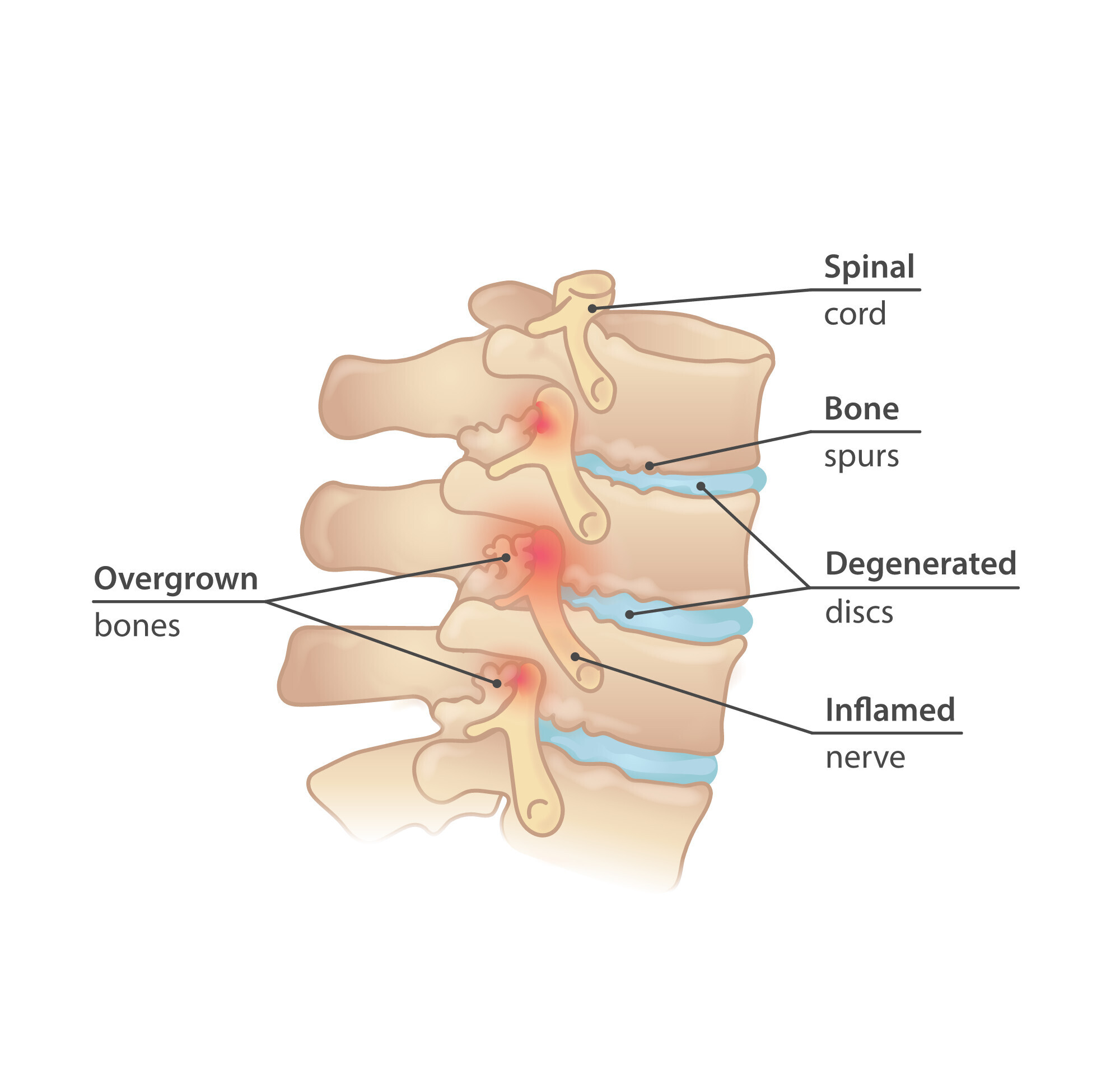
Image Source: www.Injurymap.com
Why Do Some Degenerated Discs Hurt When Most Don't?
Pain associated with disc degeneration usually comes from one of a few sources. The outer third of the annulus contains nerve endings, so fissures or irritation in that outer ring can generate localized back or neck pain, often worse with prolonged sitting, bending, or loading. As discs lose height, the facet joints behind them bear more compression, and these joints can become an independent pain source, typically felt with extension and rotation. In some cases, disc height loss and osteophytes narrow the openings where nerve roots exit the spine, producing radiating symptoms like sciatica in the leg or pain and tingling into the arm. And surrounding muscles often tighten protectively around an irritated segment, adding a layer of aching stiffness on top.
Critically, the amount of degeneration visible on imaging correlates poorly with pain. People with dramatic-looking MRIs can be pain-free, while others with mild findings hurt considerably. That's why treating the person and their movement, rather than treating the picture, is the right approach.
Common Symptoms of Symptomatic Disc Degeneration
When disc degeneration does cause symptoms, the typical pattern is chronic, low-grade back or neck pain that flares periodically, often worse with prolonged sitting, bending, or lifting, and frequently eased by changing positions or walking. Morning stiffness that loosens with movement is common. Some people experience episodes of more intense pain lasting days to weeks, separated by long stretches of manageable or minimal symptoms. If nerve roots are involved, symptoms can extend beyond the spine: radiating pain, numbness, or tingling into the leg with lumbar (low back) involvement, or into the shoulder, arm, or hand with cervical (neck) involvement.
How Does a Chiropractor Treat Degenerative Disc Disease?
The goal of care is reducing pain, restoring motion, and building the strength and habits that let you live fully with a spine that's simply showing its mileage. At Modern Care Chiropractic, treatment typically includes several components.
A thorough evaluation. We assess your spinal motion, posture, and movement patterns, review any imaging, and identify which structures are actually generating your pain, whether that's the disc, the facet joints, irritated nerve roots, guarded muscles, or some combination. We also screen for the uncommon signs that warrant referral for advanced imaging or specialist care.
Targeted adjustments and mobilization. Degenerated segments and their neighbors often stiffen, forcing other levels to compensate. Gentle, specific adjustments restore motion to restricted segments and unload overworked facet joints, reducing pain and improving how the spine shares load. Techniques are always adapted to your spine; low-force methods are available where appropriate.
Soft tissue therapy. Myofascial release and trigger point work address the protective muscle guarding that layers stiffness and aching on top of the underlying problem.
Class IV therapeutic laser therapy. Laser therapy can help calm inflammation around irritated joints and nerve tissue, supporting the manual treatment.
Strength and mobility programming. This is the long game. Strong core and spinal muscles act as shock absorbers that reduce load on the discs, and disc tissue itself stays healthiest with regular movement, since discs receive nutrition through motion-driven fluid exchange rather than direct blood supply.
Lifestyle guidance. Sitting habits, lifting mechanics, sleep setup, and activity pacing all influence how a degenerated segment feels day to day, and small changes here compound.
Most patients notice meaningful improvement within four to six weeks of consistent care, and flare-ups become less frequent and less intense as strength and mobility build.
What Can You Do at Home?
Movement is medicine for aging discs. Regular walking is one of the best low-cost therapies available for degenerative disc symptoms, and consistent core and back strengthening builds the muscular support that takes pressure off the spine. Break up long sitting with position changes every 30 to 45 minutes, use good lifting mechanics by keeping loads close to your body, and maintain a healthy weight, since extra load accelerates wear on discs and facet joints. Staying hydrated supports disc tissue as well.
What you should avoid is the instinct to rest and protect your back long-term. Prolonged inactivity weakens the very muscles your spine relies on, stiffens the segments further, and tends to amplify pain rather than relieve it. A degenerating disc is not a fragile disc.
When Should You See a Professional?
If back or neck pain is recurring, interfering with sleep or work, or radiating into a limb, an evaluation can identify what's driving it and get you on a plan. Seek prompt medical attention if you experience progressive weakness in a leg or arm, numbness in the groin or inner thighs, or changes in bladder or bowel control, since these rare signs can indicate significant nerve compression that needs urgent assessment.
Frequently Asked Questions About Degenerative Disc Disease
Is degenerative disc disease actually a disease?
No. Despite the name, it's not a disease in the usual sense. It's a label for the normal age-related changes discs undergo, including water loss, height loss, and small fissures in the outer ring. These changes appear on the imaging of most middle-aged adults, the majority of whom have no pain.
Will my degenerative disc disease keep getting worse?
The imaging findings tend to progress slowly with age, but symptoms usually don't follow the same trajectory. Many people find their pain improves over time, particularly with strengthening and activity, and research shows some discs become less painful as they stiffen with age. Progressive imaging does not mean progressive pain.
Can a chiropractor help with degenerative disc disease?
Yes. While no treatment reverses disc degeneration, chiropractic care effectively addresses what actually causes the pain: restricted spinal segments, overloaded facet joints, muscle guarding, and nerve irritation. Care combining adjustments, soft tissue therapy, and progressive strengthening reduces pain and improves function.
Is it safe to exercise with degenerative disc disease?
Yes, and it's strongly encouraged. Exercise is one of the best-supported treatments for disc-related pain. Discs receive their nutrition through movement, and strong supporting muscles reduce spinal load. The right program is progressive and tailored to your symptoms, which is where professional guidance helps.
What's the difference between degenerative disc disease and a herniated disc?
Disc degeneration is the gradual age-related change in disc structure. A herniated disc is a specific event where the inner gel-like material pushes through a tear in the outer ring, which can irritate nearby nerves. Degeneration can make herniation more likely, but they're distinct findings, and each can exist without the other.
Will I need surgery for degenerative disc disease?
Very unlikely. The overwhelming majority of people with symptomatic disc degeneration improve with conservative care. Surgery is generally considered only for significant, progressive nerve compression or cases where a well-executed course of conservative treatment has failed and symptoms remain disabling.
Take the Fear Out of Your Diagnosis at Modern Care Chiropractic
At Modern Care Chiropractic, we'll explain what's going on in your spine, treat what's genuinely causing your pain, and build the strength and confidence that let you move without fear.
Ready to get started? Give us a call at 702-900-2709 or use our online booking site to schedule your evaluation today.
This article is for informational purposes only and is not a substitute for professional medical advice, diagnosis, or treatment. Always consult a qualified healthcare provider about your specific condition.