Spondylolisthesis vs. Spondylosis: Two Confusing Diagnoses, Explained Clearly
Few diagnoses generate more confusion than spondylolisthesis and spondylosis. They sound nearly identical, they often show up in the same imaging report, and they're frequently mixed up even in casual conversation between providers. But they describe two different things, and understanding which one you have, or whether you have both, matters for making sense of your back pain and your treatment options.
In this article, we'll untangle the terminology, explain what each condition actually is, cover the symptoms and causes of both, and walk through how chiropractic care at Modern Care Chiropractic helps manage them.
First, the Terminology
All of these terms share the Greek root "spondylos," meaning vertebra, which is why they blur together. Here's the quick decoder:
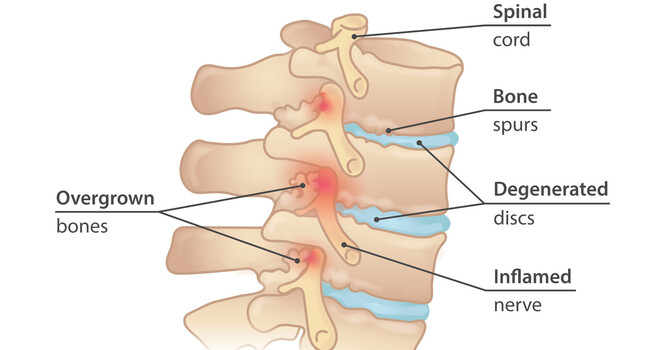
- Spondylosis is the umbrella term for age-related degeneration of the spine, including disc wear, facet joint arthritis, and bone spur formation. If you've read our article on degenerative disc disease, spondylosis is a closely related label describing the same family of changes.
- Spondylolysis (note the "lysis") is a stress fracture or defect in a specific part of the vertebra called the pars interarticularis, a thin bridge of bone connecting the joints at the back of the vertebra.
- Spondylolisthesis is the actual slippage of one vertebra forward relative to the one below it. The word combines "spondylos" with "olisthesis," meaning slipping.
The three are related: spondylolysis can allow spondylolisthesis to develop, and spondylosis is a common cause of spondylolisthesis later in life. But each term means something distinct, and imaging reports often mention more than one.
What Is Spondylosis?
Spondylosis describes the cumulative wear-and-tear changes that develop in the spine over decades. The discs gradually lose water content and height, the facet joints at the back of each segment develop arthritis as they absorb more load, ligaments thicken, and the body lays down small bony growths called osteophytes in response to the changing mechanics. These changes are extraordinarily common, appearing on the imaging of most adults by middle age, and like disc degeneration, they frequently exist without causing any symptoms at all.
When spondylosis does cause symptoms, the usual pattern is aching stiffness in the low back or neck that's worse in the morning or after inactivity, improves with gentle movement, and flares with overactivity. If bone spurs or thickened tissue narrow the passageways for nerves, symptoms can extend into a limb, and significant narrowing of the spinal canal produces spinal stenosis, which classically causes leg heaviness or cramping with walking that eases when sitting or leaning forward.
What Is Spondylolisthesis?
Spondylolisthesis means one vertebra has slipped forward on the vertebra beneath it, most commonly at the L4-L5 or L5-S1 levels at the base of the lumbar spine. The degree of slippage is graded on the Meyerding scale: grade 1 means the vertebra has slipped up to 25 percent of the width of the vertebra below, grade 2 up to 50 percent, and so on. The large majority of cases are grade 1 or 2, which are considered low-grade and are typically managed conservatively.
The two most common types tell very different stories:
Isthmic spondylolisthesis begins with spondylolysis, the pars stress fracture mentioned above. The pars interarticularis is vulnerable to repetitive extension and rotation of the spine, which is why this type is strongly associated with youth sports like gymnastics, football (particularly linemen), diving, and wrestling. The defect usually develops in adolescence, affecting an estimated 4 to 6 percent of the population, and when it occurs on both sides, the vertebra loses its bony restraint against sliding forward. Many people with isthmic slips have no idea until the finding shows up on imaging decades later.
Degenerative spondylolisthesis develops later in life, typically after age 50, as spondylosis erodes the disc and facet joints that normally hold the segment in place. Without a pars defect, the worn joints simply allow the vertebra to glide forward. This type is most common at L4-L5, occurs more often in women, and frequently travels together with spinal stenosis, since the slippage narrows the canal.
Less common types include congenital, traumatic, and pathologic spondylolisthesis.
Symptoms of spondylolisthesis, when present, include low back pain that worsens with standing, walking, and back extension and eases with sitting or bending forward, tight hamstrings, a sensation of instability or "giving way" in the low back, and, when nerves are compressed, radiating leg pain, numbness, or tingling. As with spondylosis, the imaging finding and the symptoms don't always match; plenty of low-grade slips are painless discoveries.
How Does a Chiropractor Treat These Conditions?
Neither condition is reversed by conservative care; the slip doesn't slide back and the arthritis doesn't disappear. But for the low-grade, stable presentations that make up the large majority of cases, conservative care is the first-line, guideline-recommended approach, and its goals are exactly the ones that matter: less pain, better function, and protection against progression of symptoms. At Modern Care Chiropractic, treatment typically includes several components.
A careful evaluation. We review your imaging, establish which diagnosis (or combination) you actually have, grade and type of any slippage, and identify what's generating your current symptoms. For spondylolisthesis, this shapes everything downstream, since a stable grade 1 degenerative slip and a symptomatic adolescent pars stress injury call for different plans. We also screen for signs that warrant imaging updates or specialist referral.
Adapted adjustments and mobilization. With spondylolisthesis, the slipped segment itself is treated cautiously; the emphasis is on restoring motion to the restricted regions around it, particularly the hips, pelvis, sacroiliac joints, and thoracic spine, whose stiffness concentrates stress on the unstable level. Techniques that load the spine into extension are minimized, and low-force methods are used where appropriate. For spondylosis, gentle adjustments help maintain motion in stiffened segments and unload irritated facet joints.
Flexion-based and decompression techniques. Because both degenerative spondylolisthesis and spondylosis-related stenosis tend to feel better in flexion and worse in extension, flexion-distraction and gentle decompression techniques are often well tolerated and can ease both back and leg symptoms.
Soft tissue therapy. Myofascial release and trigger point work address the chronically guarded spinal muscles and the characteristically tight hamstrings that accompany spondylolisthesis.
Class IV therapeutic laser therapy. Laser therapy helps calm inflammation around irritated facet joints and nerve tissue.
Stabilization-focused exercise. This is the cornerstone for spondylolisthesis. Strengthening the deep core stabilizers, particularly the transverse abdominis and multifidus muscles that brace the spine segment by segment, along with the glutes, gives the slipped level the muscular control its bony anatomy no longer fully provides. Research on lumbar stabilization programs shows meaningful reductions in pain and disability for spondylolisthesis patients. Programs emphasize neutral-spine control first and avoid loaded extension early on.
Activity guidance. We help you modify aggravating activities, for adolescents this often means a temporary break from extension-heavy sports while a pars injury heals, and build a graded path back to what you love doing.
Most patients with symptomatic low-grade spondylolisthesis or spondylosis improve meaningfully within six to eight weeks of consistent care, with continued gains as stabilization strength builds.
What Can You Do at Home?
Walking within comfortable limits, staying generally active, and consistently performing your prescribed core stabilization exercises are the highest-value habits for both conditions. Maintaining flexible hamstrings and hips reduces the pull on the pelvis and low back. Pay attention to positions: for most people with these diagnoses, prolonged standing and arching backward provoke symptoms, while sitting breaks and forward-leaning positions relieve them, and you can use that pattern to pace your day. Maintaining a healthy weight reduces the load the affected segments carry.
What you should avoid, at least while symptomatic, is repetitive loaded extension, think heavy overhead pressing with an arched back, and the opposite trap of abandoning activity altogether. A deconditioned core is precisely what a slipped or arthritic segment can't afford.
When Should You See a Professional?
If you have back pain that follows the patterns described here, a known diagnosis of either condition with worsening symptoms, or an adolescent athlete with persistent low back pain, especially in an extension-heavy sport, an evaluation is worthwhile. Adolescent back pain that lasts more than a couple of weeks deserves assessment, since an active pars stress injury caught early heals far better than one played through. Seek prompt medical attention for progressive leg weakness, worsening numbness, significant changes in walking, or any changes in bladder or bowel control, since these can indicate advancing nerve compression that needs urgent evaluation.
Frequently Asked Questions About Spondylolisthesis and Spondylosis
What's the difference between spondylosis and spondylolisthesis?
Spondylosis is general age-related degeneration of the spine, including disc wear, facet arthritis, and bone spurs. Spondylolisthesis is the forward slippage of one vertebra on the one below it. They're distinct findings, though spondylosis is a common cause of spondylolisthesis in adults over 50.
Is spondylolisthesis serious?
Usually not. The large majority of cases are low-grade (grade 1 or 2), stable, and managed successfully with conservative care built around core stabilization. Higher-grade slips, progressive slippage, or significant nerve compression are less common and warrant specialist involvement.
Can a chiropractor help with spondylolisthesis?
Yes, with care adapted to the diagnosis. Treatment emphasizes restoring motion to the stiff regions around the slip, easing muscle guarding, and above all building deep core stabilization to give the segment muscular control. The slipped level itself is treated cautiously, and extension-loading techniques are minimized.
Can spondylolisthesis get worse?
Low-grade slips in adults are usually stable, and significant progression is uncommon, particularly once skeletal growth is complete. Adolescents with higher-grade slips carry more progression risk and are monitored more closely. Symptoms, importantly, can improve substantially even though the slip itself doesn't move back.
Why do my hamstrings feel so tight with spondylolisthesis?
Hamstring tightness is a classic accompaniment. It's thought to be a protective response, with the hamstrings tensing to tilt the pelvis and reduce shear stress on the slipped segment. The tightness typically eases as core stability improves and the segment calms down, which is why stretching alone rarely fixes it.
Get Clarity and Relief at Modern Care Chiropractic
Confusing terminology shouldn't stand between you and understanding your own spine. At Modern Care Chiropractic, we'll explain exactly what your diagnosis means, what's driving your symptoms, and build the stabilization-focused plan that helps you move confidently again.
Ready to get started? Give us a call at 702-900-2709 or use our online booking site to schedule your evaluation today.
This article is for informational purposes only and is not a substitute for professional medical advice, diagnosis, or treatment. Always consult a qualified healthcare provider about your specific condition.